
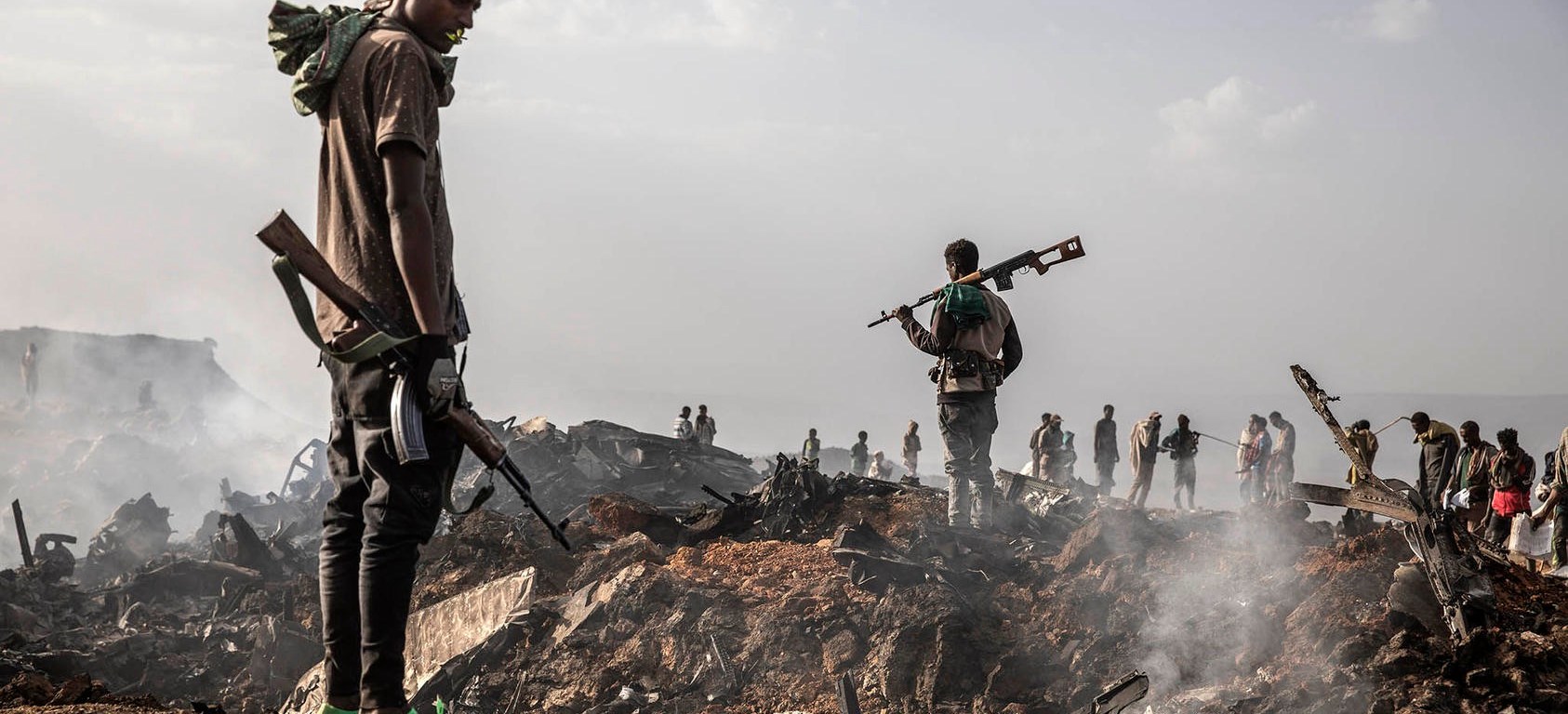
Written by Max Kaczmarczyk
It can be widely thought that conflict in humans is common. In Niccolò Machiavelli’s The Prince he says, “The desire to acquire possessions is truly very natural and ordinary, and when men who can do so are successful, they will always be praised and not blamed, but when they cannot and want to do so at all costs, here there is error and blame”. Hence showing, humans will always tend to want things, and many will look upon, in this case, The Prince, to understand this willingness to desire more.
Throughout history, there has always been conflict, for which the reasons have been down to physical geography, such as one village having a better strategic position than another or a village may have good trade routes, so they will be at a higher risk of conflict compared to those with worse routes. A large driver in conflict has been, and still is, religious or political ideologies/statuses, with conflicts such as Israel-Palestine occurring for such reasons.
All impacts of war can cause devastating social, economic, and environmental destruction. On average, the most damaging wars can cause a decline in GDP by around 40-70%. Government military spending will almost always increase, so how do these extreme surges in costs affect a country?
In many cases, especially in smaller countries, loans may be taken out from banks or wealthy countries, such as the UK. Depending on how long and damaging the conflict is, a borrowed sum may continue to build up interest, increasing the debt over time. So much so, that the country could go into default, and trade with other nations could be near impossible without any external help, even after the conflict is over.
War has devastating environmental effects, with conflict destroying animal habitats, reducing biodiversity, which can create to decade-long strains on the food chain. War can also indirectly affect soil; where a rise in demand for food can lead on to over-cultivation, where the soil is unavailable for use. Furthermore, such cases where food is difficult to produce during conflict can carry heavy social pressures, with people not knowing when their next meal may be. As a result, people may move towards looting and violence in order to survive.
Ethiopia’s Civil War:
History:
Ethiopia is a nation in the east of Africa, with a rich culture and over 80 languages spoken across the country. Tigray is the northernmost region and fifth largest state in Ethiopia. Tigray is considered to be the origin of Ethiopian civilisation, with its history going as far back as 980 BC, making it hold great value to Ethiopians.
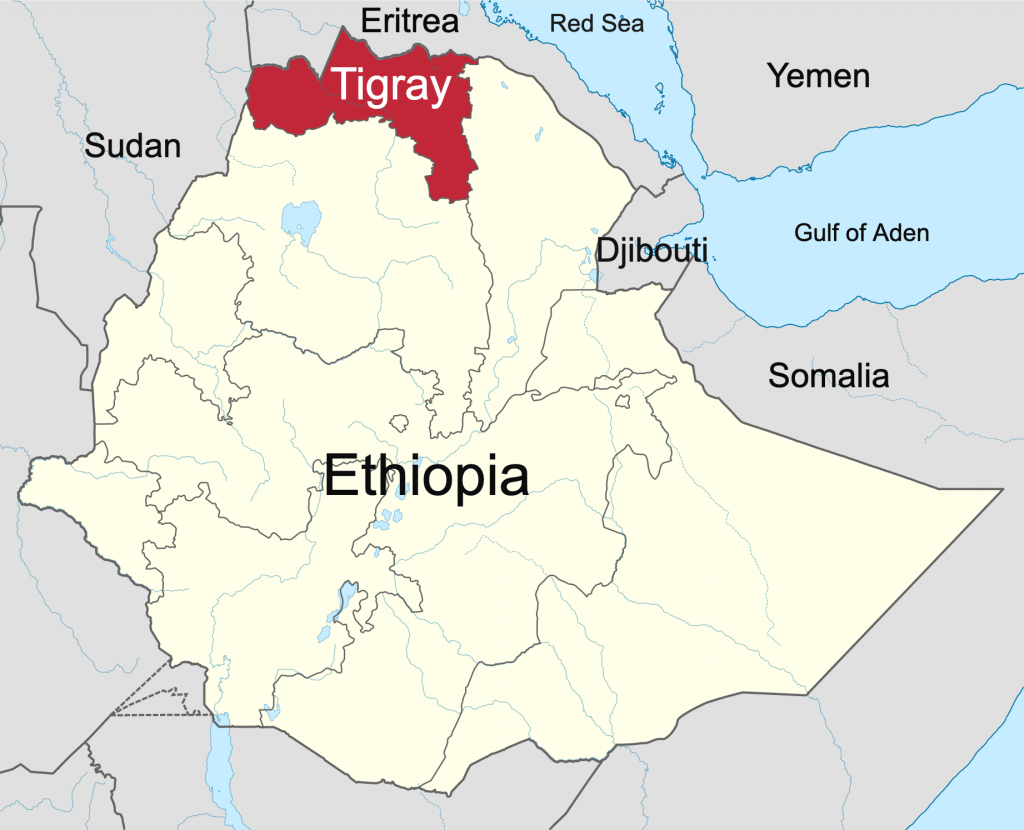
The Tigray People’s Liberation Front (TPLF) is a political party which primarily represents the region of Tigray. The TPLF governed Ethiopia for many years, from 1991 until 2018, when they were removed from power, and Abiy Ahmed Ali became Prime Minister, with many Ethiopians seeing him as a symbol of peace and redemption for Ethiopia. Abiy Ahmed embraced this, and offered to provide a better sense of community for the country. In 2019, Abiy won the Nobel Peace Prize for ending violence on the Eritrean border. However, not even a year had passed when this promised idea of community was beginning to break down, with many delays of national elections and a proposed declaration of an extension of Abiy Ahmed’s first term as Prime Minister angering Tigrayan officials. Eventually, the Tigray State Council held local elections, which the TPLF won. As a result, Abiy Ahmed accused TPLF troops of attacking a federal military camp in order to acquire weapons, thus initiating what would be the start of extremely high tensions between the political parties.
On 4th November 2020, Abiy Ahmed sent Ethiopian National Defence Force troops into the Northern regions to begin an attack called the Mekelle Offensive in Tigray. Over the following months, the level of danger ramped up, and Tigrayan troops boosted their military response, effectively commencing what would be known as the Tigray War.
Impact:
There have been many social repercussions as a result, with the war spreading out onto neighbouring regions of Afar and Amhara, affecting over 20 million people, 75% of which were women and children, with 5.5 million having to flee their homes. It has been confirmed that around 600,000 people have died as a result of the conflict.
The United Nations estimates that 20 million Ethiopians are currently experiencing food insecurity, after a three year drought in most parts of East Africa, along with the Tigray War, prevented people to produce enough food to survive. As a result, the International Rescue Committee’s Emergency Watchlist ranked Ethiopia as the second most at risk of worsening humanitarian crisis in 2023, after Somalia. The Ethiopian economy also received numerous blows as a result of both the Tigray War and external factors. The following graph compares the inflation rate of Ethiopia and the rest of the world:
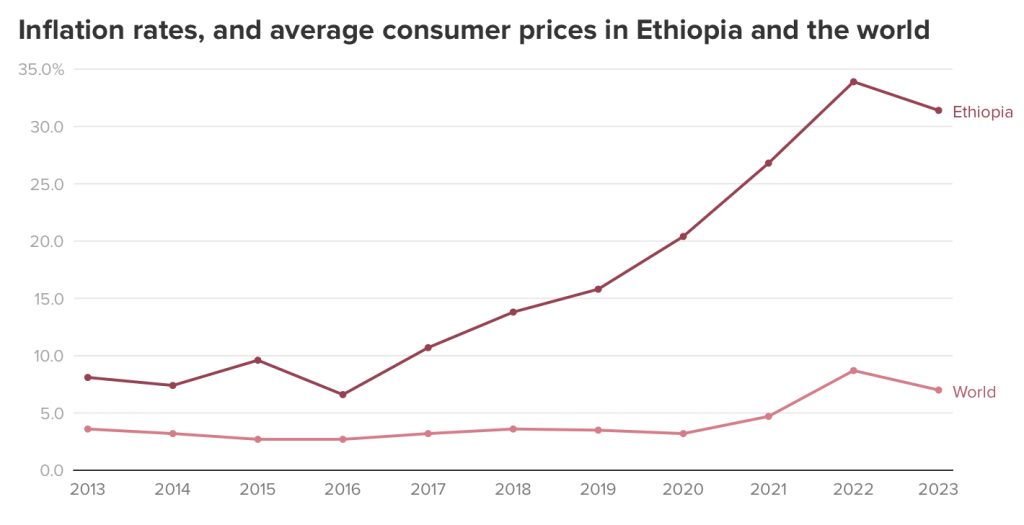
The graph shows a rapid increase in the inflation rate from 20.4% to 33.9% from 2020 to 2022. Both Ethiopia and the World experienced an increase in 2022, but it is clear that Ethiopia was a lot more sensitive to this rise. This is due to a large number of factors, including the civil war, but also due to the effects of Covid-19, drought, and other conflict going on in the world, such as the Ukraine war; where Ethiopia being a country which relies so heavily on imports can cost it so much economically. For reference, Ethiopia imports nearly US$2 billion worth of fertilisers every year. Given that Russia is the biggest exporter of nitrogen-based fertiliser, the increase in commodity prices as a result of the Ukraine War certainly led to an increase in the rate of rising fertiliser prices, shown by the graph:
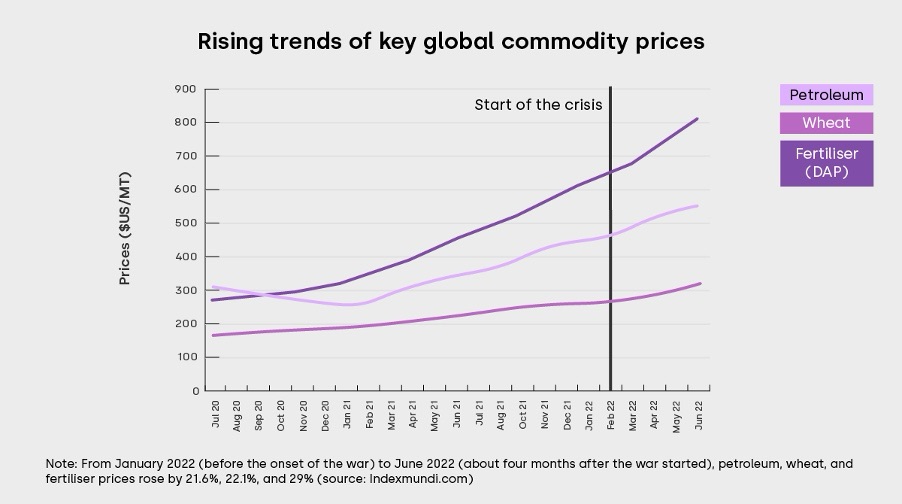
Note how after December 2020, the price of fertiliser in Ethiopia started to accelerate, which is shortly after the Tigray War officially started. The line labelled “Start of the crisis” shows when the Ukraine War commenced, with the price of fertiliser ascending even higher. This is just one example of how external factors have also helped to encourage a high rate of inflation in Ethiopia, putting increasing amounts of pressure on the Ethiopian economy.
The economic ramifications of the conflict in northern Ethiopia cost $22.7 billion worth of damage to infrastructure, and $6 billion in productivity losses. Approximately 85% of employment in Ethiopia is agriculturally based, so it would make sense that it was the hardest hit sector, with it sustaining 59% of these losses, because there was an increase in the number of cases of violence, including vandalism, interruptions of planting, and looting.
The Tigray War has had significant environmental costs, impacting the region’s ecosystems and natural resources. The following image displays what was previously farmland, but has been trodden and destroyed by Eritrean soldiers in the Ahferom district, Tigray:
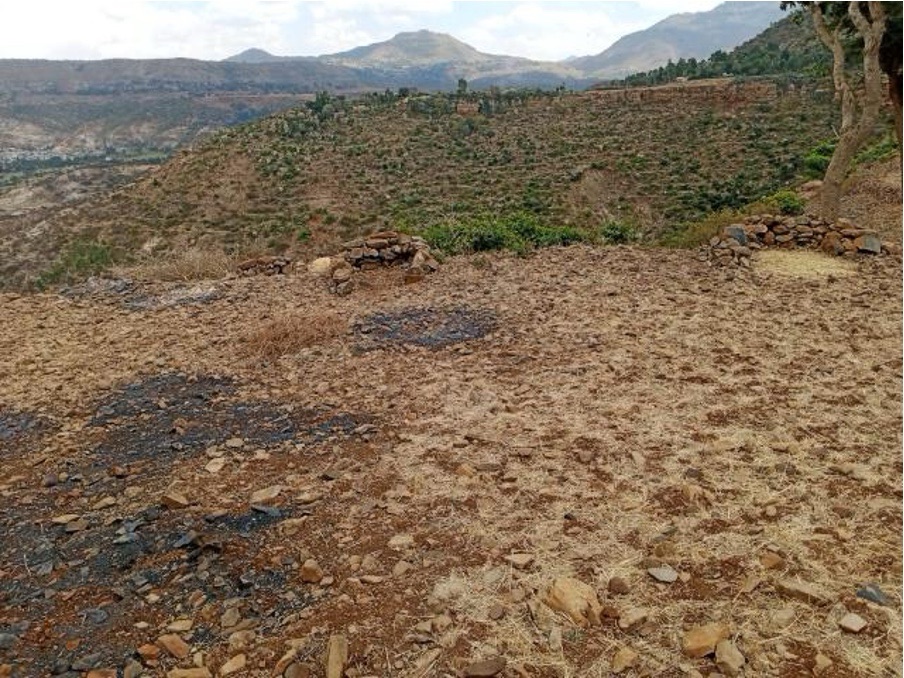
Previously, the Tigray region had won multiple awards for its land restoration; with a rehabilitation programme, which commenced in 1991, reducing the amount of rainwater runoff, improving soil quality, and increasing feed, food and fuel availability. Forest cover in the area also increased from 3% to 17%. However, all of this was halted when the conflict started, with many of the restored areas destroyed as a result of areal and ground bombing, harmful chemicals, and vehicle and army movement, as shown in the photo above.
How have other countries and organisations helped?
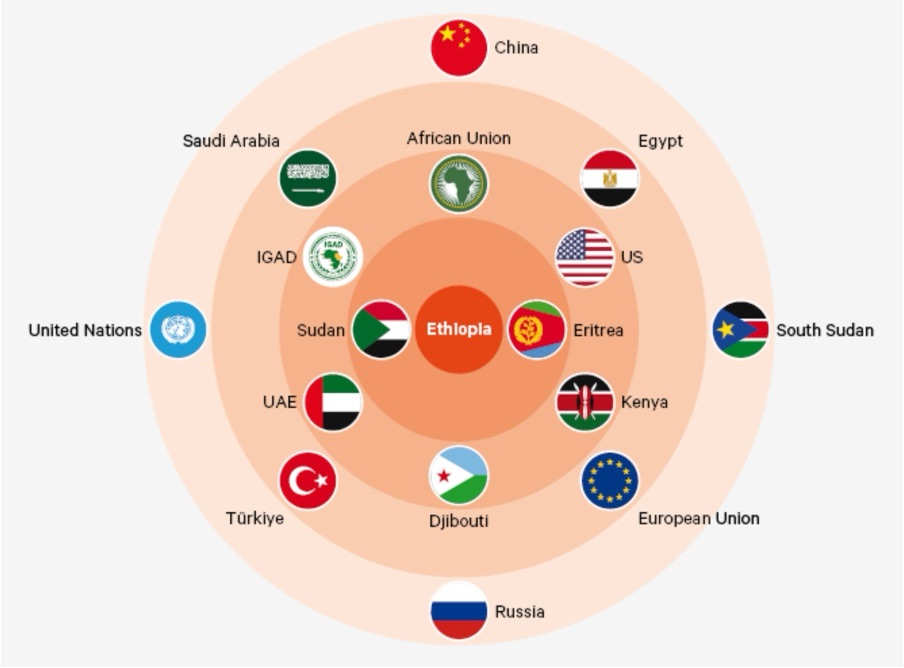
The sphere of interest and influence on the Tigray War shows which countries have contributed the most. A large financial outreach of the USA was shown, with them sending around $1.8 billion to Ethiopia in 2022. The UAE sent military support in the form of drones at the start of the war in November 2020. Out of all of Türkiye’s investments in Africa in 2020, its largest was the $2.5 billion it gave to Ethiopia. In January 2022, evidence emerged of a Turkish drone killing 58 civilians staying in a school in Tigray. Türkiye prides itself in being one of the top drone manufacturers, but has been internationally criticised for aiding the use of drones in killing civilians. This then raised the question as to whether sending military equipment used to commit war crimes is reasonable, especially with the rising use of drones. In September 2021, the White House incremented sanctions for anyone involved with the humanitarian and human rights crisis in Ethiopia. However, a more comprehensive set of regulations was included after the Turkish drone attack, with the rules becoming effective in February 2022.
Conclusion:
In November 2022, nearly two years after the war had started, a peace deal was offered to end the conflict in the northern Tigray region. However, all is still not over, as global economic impacts from the Ukraine War, and Ethiopia’s droughts have meant that food insecurity is at an extremely concerning level. Around $1.66 billion is required to help resolve Ethiopia’s drought, and at the end of 2022, only 42% of this was funded.
Conflict will almost certainly bring a country down, whether it be financially, socially, or environmentally. In the case of Ethiopia, the Tigray War halted how they function, with nationwide famine and social unrest. Perhaps there is no long term solution to this, and it may prove to be many years before Ethiopia can resolve its civil problems.
Bibliography:
- Niccolò Machiavelli – The Prince (1532)
- Centre For Preventive Action– Conflict in Ethiopia https://www.cfr.org/global-conflict-tracker/conflict/conflict-ethiopia#RecentDevelopments-2
- The New Humanitarian – Boom to bust: Fallout of war and drought leaves Ethiopians mired in poverty (2023) https://www.thenewhumanitarian.org/news-feature/2023/08/01/boom-bust-fallout-war-and-drought-leaves-ethiopians-mired-poverty#:~:text=Cost%20of%20conflict,to%20an%20Ethiopian%20government%20assessment.
- International Rescue Committee – Crisis in Ethiopia: Drought and conflict put 28 million in need (2023) https://www.rescue.org/article/crisis-ethiopia-drought-and-conflict-put-28-million-need
- Dr Demissie.A: Chatham House – Navigating the regionalisation of Ethiopia’s Tigray conflict (2023) https://www.chathamhouse.org/2023/09/navigating-regionalization-ethiopias-tigray-conflict/02-mediation-efforts-and-role-regional
- Negash.E, Birhane.E: Ethiopia Insight – War and siege inflicted damage on Tigray’s ecosystem (2023)
- Gebrekirstos.A, Birhane.E: The Conversation – The war on Tigray wiped out decades on environmental progress: how to start again (2023)
- https://theconversation.com/the-war-on-tigray-wiped-out-decades-of-environmental-progress-how-to-start-again-201062
- Tamru.S, Gebrewolde.T: International Growth Centre – Impact of the Russia-Ukraine war on Ethiopia (2022)
- https://www.theigc.org/blogs/impact-russia-ukraine-war-ethiopia
- Joseph R. Biden Jr: The White House – Executive Order on Imposing Sanctions on Certain Persons With Respect To Humanitarian and Human Rights Crisis in Ethiopia (2021)
- https://www.whitehouse.gov/briefing-room/presidential-actions/2021/09/17/executive-order-on-imposing-sanctions-on-certain-persons-with-respect-to-the-humanitarian-and-human-rights-crisis-in-ethiopia/?itid=lk_inline_enhanced-template

 The Cannon Yarder