
By Frederick A
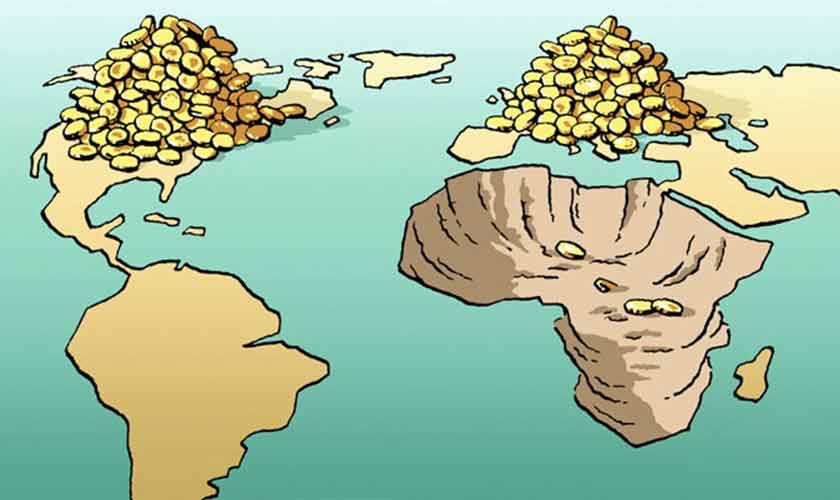
Neocolonialism is the the use of economic, political, cultural, or other pressures to control or influence other countries, especially former dependencies. This can lead to countries being exploited for the resources and labour while not being ruled or governed by the old colonisers. Through neocolonialism, the more technologically advanced nations ensure their involvement with low income nations, such that this relationship practically annihilates the potential for the development of the smaller states and contributes to the capital gain of the technologically advanced nations Conceptually, the idea of neocolonialism can be said to have developed from the writings of Karl Marx (1818-1883) in his influential critique of capitalism as a stage in the socio-economic development of human society, however we first see the concept of neocolonialism really come to light after the end of WW2.
Neocolonialism is generally seen as a bad thing and for good reasons. There is an intrinsic link between colonialism and contemporary forms of racism, racial discrimination, xenophobia and intolerance faced by Africans, people of African descent, people of Asian descent and indigenous peoples. On top of this the developed, European countries, still exploit the old colonies and utilise them for their economic resources. While decolonisation gave ex-colonies freedom it only gave them seldom opportunities to exploit it to full advantage because of economic decolonisation.
Due to the exploitation of resources, ex-colonies have experienced economic underdevelopment and will take a significant amount of time to recover from the loss of resources and economic growth they could have gained from making proper use of their resources. Neocolonialism has also lead to a great amount of environmental degradation as large TNCs which appear in less developed countries generally don’t abide by the environmental laws and regulations and cause much environmental damage through over exploitation of the environment. A example of this is the 2006 Ivory Coast toxic waste dump. The Probo Koala, chartered by the Singaporean-based oil and commodity shipping company Trafigura Beheer BV, offloaded toxic waste to an Ivorian waste handling company, when the local contractor dumped the waste at 12 sites. This caused massive environmental damage and lead to over 100000 people seeking medical attention due to the toxic waste. The waste was initially meant to be dumped in Amsterdam however due to it being to expensive and it having regulations, they opted to dump the waste in a less developed and cheaper country. This lack of care and regard for ex-colonies really enforces how neocolonialism can have a very negative effect on the ex-colonies and lead to a lot of damage.
Another way in which we can see how neocolonialism is a problem is through how it has large racist and xenophobic roots. The negative impact of colonialism on indigenous peoples had resulted in systemic racism, poverty, economic inequity, violence, over incarceration, poor health, dispossession of traditional lands and territories, criminalization of indigenous human rights defenders, loss of language and culture, and violence and discrimination against women and girls. Now while neocolonialism doesn’t directly add to this problem, it doesn’t aid in helping to eradicate the problem either. Colonialism formed a prejudice within skin colours and this prejudice has proven to be difficult to overcome. Even today, these racialised structures hold immense power, shaping who has advantages and who faces discrimination. E. Tendayi Achiume, then Special Rapporteur on contemporary forms of racism has stated that “at least one legacy” of colonialism is a “world where race and ethnicity determine, for many people, whether or not they enjoy fundamental human rights.” A strong example of this is the Windrush scandal. The Windrush generation is a select group of men and women from the Caribbean who were bought to England from 1940-1970 to fulfil the labour shortage. Due to the introduction of the hostile environment policy in 2012, the rights of the Windrush generation were compromised. The demand to provide documentation for each year of residency and many of the generation that arrived as children on their parents passports the Home Office made it virtually impossible for many to legitimately stay in the UK. This resulted in many people being wrongfully detained despite many of the Windrush generation contributing heavily to the NHS. This shows how there are still many problems to do with racism as a result of colonialism and how it has carried on into neocolonialism.
As a result of all the negative impacts of neocolonialism the development of democracies in these ex-colonies have been hindered greatly and corruption is still a large problem in most of the sub Saharan countries that were once ex-colonies. This corruption and lack of democratic institutions has lead to these ex-colonies recovery being stunted and kept them from attempting to gain true independence from the ex-colonial powers. Another problem that we are seeing is that as Africa slowly frees itself from the effects of neocolonialism, China is now inserting itself more and more into Africa. This doesn’t bode well for a quick reassertion of stable democratic governance and values and may lead up to these countries still suffering and being unable to utilise their resources to their full extent
 The Cannon Yarder